

If you just take the cork out of a bottle or remove the screwcap instead – provided it is so fortuitously sealed – then you will do very little to breathe the wine inside. For better or worse, this is just the first step of the process.
When you breathe a wine you’re hoping for some of the pongier smells often associated with reduced sulphur to escape into the atmosphere, while you’re also hoping that a little oxygenation sharpens up some of its flavours. How small is the aperture at the top of a bottle? How on earth will all this gas exchange occur throughout the entirety of the wine inside, especially when some of it is around 20 cm from the tiny opening? It’s not sufficient, though, just to leave a bottle standing there with its cork out. It would eventually of course, but by then it’s likely that excessive oxidation would also be happening as well. The surface area of the exposed wine in the bottle is simply far too small to permit anything other than minuscule evaporation and dissolving of oxygen, especially when compared to the comparatively broad expanse of wine’s surface inside a decanter.
Let’s leave aside for the time being the multitude of devices sold in gift stores that are supposed to do this for you. Honestly, they’re a waste of time if you have the appropriate glassware at hand – a spotlessly clean wine decanter or glass jug. But before we start, there are some things worth remembering.
As mentioned above, breathing encourages two simultaneous responses. Firstly, an old wine may contain some slightly pungent or ‘off’ characters which can dissipate into the atmosphere and out of the wine. I wouldn’t suggest that it is possible to remove all smells in this manner, but the bouquet can certainly be ‘cleaned up’ through a spell of breathing.
The second thing that happens is that oxygen is able to get to the wine, and through a slight oxidation process is able to sharpen the edge on many of its flavours, enhancing their attraction and depth. So, as a wine breathes it improves with the loss of undesirable flavours, while the ‘winey’ flavours are made more apparent to the drinker. You do it simply by leaving the wine open for a period prior to drinking – in a decanter. By decanting you immediately and comparatively gently aerate the wine, thereby reducing the time required for it to breathe to its most drinkable degree.
As wines increase in age, so must the care you take in presenting them. To do full justice to a mature red wine, leave the bottle upright for several hours to encourage any sediment or deposit to settle at the bottom. If you breathe it for too long, it can rapidly oxidise and deteriorate, losing its remaining qualities of flavour. So never leave old wines (twenty years of age and more) to breathe for two or three hours or more. Old wines should be opened around half an hour before they are ready to be drunk. Once opened, immediately sniff the top of the bottle. If it smells sweet and fragrant, the cork should be re-inserted (the same way as before), or if this is not possible, then a clean cork should be inserted instead. These wines will not require that half-hour’s breathing.
The rules of thumb are these: young reds generally need longer to breathe than old ones, and full-bodied reds need longer than more delicate wines. A long period of breathing is around three hours; a short period about fifteen minutes. Therefore, give a full-bodied young wine the full three hours, and delicate older, ones about fifteen minutes or more, depending on how they smell when opened. Younger reds can submit to a harsher treatment. By pouring them alternately from one decanter or carafe to another, you thereby impose a gentle, extended and effective process of aeration.
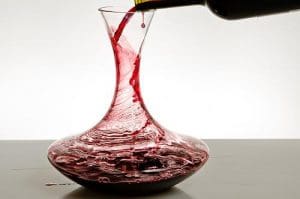
And when pouring the wine into either a decanter or a jug, try to do it in a way that creates a thin film of wine that adheres to the inside of the vessel, as you see in the accompanying picture. That’s as pure, gentle and simple a means of aeration as you will ever need.
Interestingly, some older wood-aged chardonnays from Burgundy and elsewhere can also appreciate a short period of breathing.