

Today, at time of writing, everyone concerned with Australian wine is losing sleep over the investigations by the Chinese Government into Australian wine which commenced on August 18. The China Alcoholic Drinks Association has appealed to its relevant authority, the Ministry of Commerce (MOFCOM) to investigate its claims that it has lost dramatic shares of market, sales and profitability because Australian wine producers have on one hand been dumping their products at unreasonably low prices and on the other, receiving unfair levels of government assistance.
What’s at stake? On October 18 China could announce a new wine tariff or even an advance deposit payable by exporters of Australian wine to China of a potential future tariff. Then, once the investigation concludes, which could be pretty well any date after 18 August 2021, the real medicine – if it is to be applied – will be subscribed. The China Alcoholic Drinks Association is requesting the imposition of duties in the order of 290%.
That would snuff China out completely as an export destination for Australian wine. But is that likely?
Observers of the Australia-China relationship – of which after about 65 trips I count myself as an L-Plater – have been waiting for some kind of wine-related trade issue ever since it was flagged by China’s Ambassador to Australia, Jingye Cheng, on April 26 when he said: ‘maybe the ordinary (Chinese) people will think why they should drink Australian wine or eat Australian beef’. Words like this are never accidental. But they were made in the context of Chinese people not feeling ‘friendly’ towards Australia. Which means they have nothing to do with wine. Indeed, it’s likely the new investigations have little to with wine, but much more to do with geopolitics.
Be sure about this – when Chinese people are determined to deliver excellence, they do. This is why I think twice about the submission itself, which contains an extraordinary number of spurious claims and numbers which simply could never be substantiated.
For instance, MOFCOM alleges that from 2015 to 2019 its domestic wine industry lost market share from 74% to 50%, lost sales revenue from 466 billion Yuan (around $90 billion AUD) to 145 billion (around $27 billion AUD) and saw profit reduced from 52.1 billion Yuan (around $10 billion AUD) to 10.6 billion Yuan (around $2 billion AUD). To put these numbers in perspective, the entire Australian wine industry has a turnover of less than $10 billion AUD. The idea that in back 2015 the Chinese wine industry was more than nine times this scale is inconceivable.
MOFCOM claims that wine consumption in China declined by 41% from 2016 to 2019, while at the same time acknowledging that the OIV rates China as ‘one of the countries with the fastest growth in global wine consumption’.
It also claims that Australian wine is broadly sold in China for one-third of its usual price and that while the price per litre of Australian wine in China declined by 13.4% from 2015 to 2019, wine from unspecified ‘other countries’ apparently declined by just 2.9%.
 Wolf Blass Yellow Label on JD.com, 31 August. No dumping here.
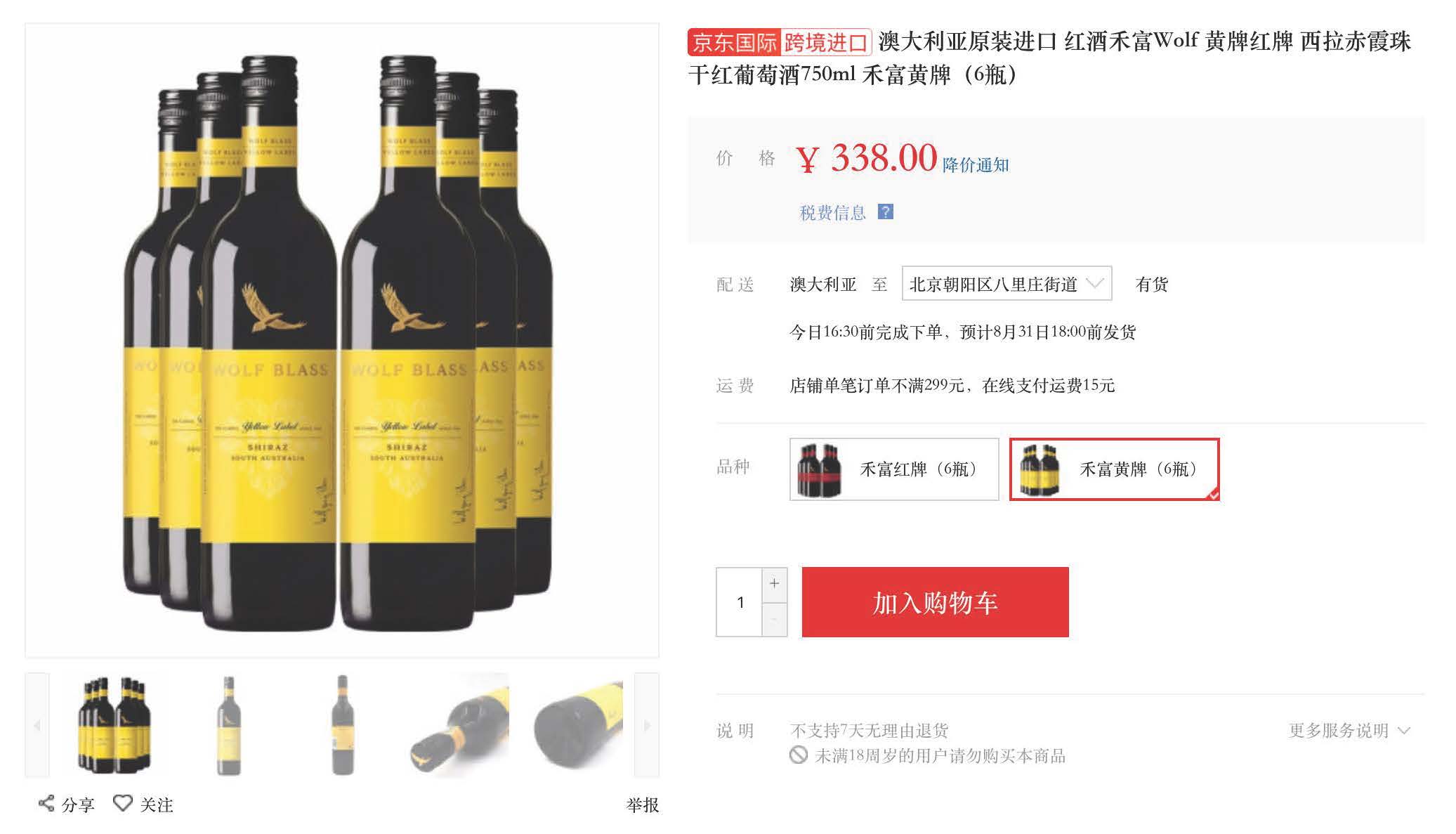 Wolf Blass Yellow Label on JD.com, 31 August. No dumping here.
Importantly, since this is critical to the dumping case, MOFCOM argues that as far as the Chinese consumers are concerned, Australian and Chinese wines are interchangeable. The report states that ‘there is competition and substitution between each other (Chinese and Australian wines) and that there is ‘no substantial difference in customer groups’. The fallacy of this argument is obvious to anyone who has worked in the China wine industry. Otherwise Chinese wines sales would surely be booming.
Of the ten companies listed for investigation, one is a small maker in Pemberton that has not exported to China for the last 5 years, another is a small Tasmania maker that has not exported in this period, while another is a domestic Australian wholesaler that does not export to China, period.
MOFCOM claims that via a range of financial measures, Australian State and Federal Governments actively provide unfair advantage to wine producers selling wine in China. The list of these measures, numbering some 40 in total, includes land conservation projects, research and development tax incentives, sustainable water and drought-related grant and loan projects, energy investment and employment projects, sustainability funds and irrigation projects.
Similarly, the development of various wine industry strategic plans, export market development grants, the recent $50 million wine industry marketing grant and the National Landcare Program are identified, along with all things, the rebate from the so-called Wine Equalisation Tax, whose very existence helps to retain Australia at the top-taxing level of significant wine producing countries.
Add them all up and they pale into insignificance against what China spends developing its own rural industries.
Why, then, would China submit a report with so many holes it’s leaking? In my view, it’s not about the detail. It’s all about the politics. China knows that for us, wine is a raw nerve. This is a message to Australian government to refocus on the quality of its relationship with China.
The success of Australian wine in China – where it is the dominant importer player – is a trophy held dearly by those of us Australians who have worked for 20 years towards this outcome. The ability of brands like Penfolds to take leading positions in China have enabled huge increases in the prices of their wine and even enabled them to exclusively release some key labels such as Bin 707 within China only. Thanks to China, Penfolds has been able to massively increase its prices and profit across its entire range. But this, of course, is the polar opposite of dumping.
China knows there is no alternative global market for the Australian wine it imports and it knows we know that. That equates to leverage at government level, since wine is inextricably bound to regional tourism and sustainability.
However, having registered the more moderate recent tone from Beijing towards Australia, I don’t perceive an intention to inflict long-term damage to either Australia or its wine industry. On 26 August, The Australian’s Glenda Korporaal reported the speech delivered by Wang Xining, China’s Deputy Ambassador to Australia to the National Press Club. He said: ‘We could serve as a classic case of comparative advantages that, if working well, would make Adam Smith chuckle in his grave. We could and should make it work the best.’ Then, using a woodworking analogy, he said ‘The two economies fit each other like tenon and mortise.’
These are not fighting words.
It’s too early to say, but here’s a possible scenario. China could impose a tariff on Australian wine on October 18. An amount of say 20% would enable MOFCOM to demonstrate to the Chinese wine industry that it has been heard and its claims have been taken seriously and would hurt, but not cripple Australian wine. After a period of time, this could be reduced or eliminated.
China has already chosen not to implement a significant tariff without warning but with immediate effect. It could have done this easily.
With wine, for the time being at least, China has left the door well and truly open.